
October 30, 2025
Alum Inspires Leadership Students with Lessons from a Global Career in Public Service
KO alum Brendan Wheeler returned to campus to speak with the Leadership class, offering students an inspiring and eye-opening look into his career with the U.S. Agency for International Development (USAID) and the Foreign Service. His message to students was simple but powerful: “Participate in history—be part of it.”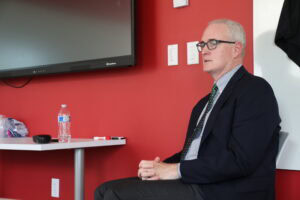
From working amid revolutions in Egypt to managing food aid in Ethiopia and rebuilding communities in Rwanda, Wheeler’s career has taken him across the globe into some of the world’s most challenging and complex environments. Through it all, he emphasized that public service is one of the most meaningful ways to make a difference.“I joined the foreign service because I wanted to experience the world and be part of shaping history,” he told students. “The best way to do that was to serve.”
After graduating from KO, Wheeler studied history and languages, which sparked his desire to work abroad. He eventually joined the U.S. Foreign Service, a branch of government that represents the United States in countries around the world through diplomacy and development work. “I got into the Foreign Service because I wanted to learn Arabic—and to keep my job, I had to,” he joked. “It wasn’t easy, but I worked through it.”
His assignments with USAID placed him in areas facing some of the toughest challenges imaginable: war, famine, revolution, genocide, and civil conflict. Despite the danger, Wheeler said the work was rewarding because he was helping to stabilize nations, rebuild communities, and improve lives.“The United States is an activist country,” he explained. “We want to shape events and influence them in our direction. It’s better for us when countries are stable and aligned with our values.”
Throughout his career, Wheeler has worked in more than a half-dozen countries—each with its own story and struggle.
Ethiopia: Managed large-scale food aid programs in rural communities, even in regions where rivers were infested with alligators.
Egypt: Helped organize elections during a time of revolution and political upheaval, working long hours for years to support democratic rebuilding efforts.
Libya: Assisted local communities trying to move forward after years of conflict and instability.
Rwanda: Helped address the long-lasting trauma of the genocide, developing programs that supported psychological healing and community rebuilding.
Iraq: Oversaw major financial operations in one of the most dangerous environments imaginable—at one point moving $120 million in cash across the country by truck and helicopter.“It was probably the most dangerous thing I’ve ever done,” Wheeler recalled.
Despite the hardships, Wheeler’s tone was deeply reflective rather than boastful. He made it clear that public service is not about glory—it’s about grit, integrity, and teamwork. When asked by students what qualities make a great leader, Wheeler answered immediately: trust. “Trust is a behavior,” he said. “Am I helping you, or am I hurting you? It’s hard to get and easy to lose.”He described his philosophy of servant leadership, where the leader’s job is to clear obstacles for their team and ensure their success. “My goal was to make sure my teams achieved their goals. Their success was my success,” he said. “The ‘I’m the boss’ approach doesn’t work. Maybe it gets short-term results, but not long-term trust.”
Wheeler illustrated how trust can become deeply personal in dangerous circumstances. He recalled a story from Iraq, when a deputy minister told him on his last day, “You were never in any danger—I never allowed it.” Only then did Wheeler realize how much his safety depended on the trust of others.
Students were eager to learn how Wheeler persevered in environments filled with danger, exhaustion, and uncertainty.“Every assignment was too much at first,” he admitted. “But professionalism and breaking things down into achievable goals got me through the dark moments.”During Egypt’s revolution, he worked sixteen-hour days for three years without weekends or holidays. His takeaway for students: find a way through difficult times by focusing on what you can control and maintaining your sense of purpose.
He also shared a powerful lesson about character—a value he said was shaped at KO. “Character is what you do when no one is looking,” Wheeler said. “No one will know if you take the easy way or the hard way, but you will—and those decisions add up. They define who you are.”
Wheeler explained that success abroad depends on more than policy knowledge—it requires cultural competence and respect. Learning local languages, eating local foods, and spending time with ordinary people—like taxi drivers—helped him understand the communities he served.“Learning about a culture and way of life is the number one priority,” he said. “Language opens doors.” His time in Jordan, where he worked closely with local mayors, reinforced that lasting change comes from relationships and understanding, not authority.
Reflecting on his own high school years, Wheeler was candid: he wished he had been more intentional.
“I didn’t have a plan when I was your age,” he said. “Whatever you want to achieve, come up with a plan and talk to people who can help you. Lay it all out. I wish I had done that earlier.”He encouraged students to develop good habits now—doing the small things right every day—because those behaviors become the foundation for lifelong success.
When asked about his outlook on America’s role in the world, Wheeler remained optimistic despite global challenges. “We’re in a period of transition,” he said. “But long-term, we’ll weather it. We always do.”
Today, Wheeler continues his commitment to public service, now working at the Connecticut Democracy Center, where he helps promote civic engagement and leadership at home. His advice to future leaders was clear:“Leadership begins with trust. Build it through your actions. Serve others first. And remember—your character will carry you through everything.”
News Main News