February 18, 2026
Claire Keegan: On Writing What It Means to be Alive
Irish author Claire Keegan, internationally acclaimed for her quiet, crystalline prose, visited KO as the 43rd Annual Baird English Symposium writer, offering students not only a reading from her celebrated novella Foster but a searching exploration of the craft of fiction in the Senior Symposium class.
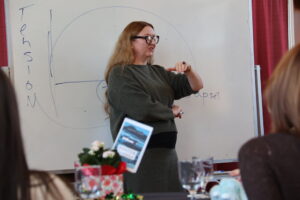
During an intimate workshop, Keegan wasted no time in sharing her arsenal of a writer’s stratagems. “A lot of people are giving you some advice on how to write,” she said. “I want to give you good advice because I know it works.” That no-nonsense, direct manner mirrors her writing style – stories with a kernel so true it breaks you inside. No contrivances. Just words. And, in her telling, a true writer must like words. “You should be liking them,” she said, “rather than simply analyzing them.”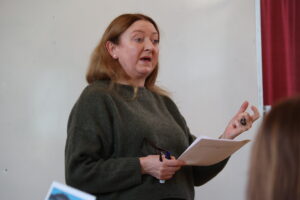
Keegan believes that the heart of storytelling is time, loss, and the emotional truth of being alive. She probed the students about what fiction “runs on.” Students provided various answers; none suited what Keegan was looking for. Conflict? Character? Imagination? “It’s time,” she said. “Fiction is contemporary art. It’s based on time that is irreversibly heading in one direction, and it ends in death.” Stories, she explained, are “an incision in time.” A writer must cut into a specific moment and allow movement to unfold. That movement, she argued, is more important than spectacle.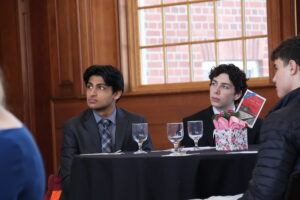
She warned students not to confuse drama with depth: “Drama can be really dull… Oh, here’s another fistfight. Oh, here’s another car crash. Anyone can take a chair and throw it through a window.” Instead, she urged them to think about loss. “Don’t substitute conflict for loss,” she said. “Loss is more interesting than conflict.” For Keegan, tension, not drama, is what keeps readers turning pages. “Everybody feels tense when they’re losing,” she said. “And that is the most interesting thing for the enterprise.”
Keegan defined character not as personality, but as behavior under strain. “Character is how you use your time,” she said. “What do you do when nobody sees you?” Personality, she explained, is a natural inclination, being extroverted, quiet, or talkative. People reveal who they truly are in moments of trouble or loss. When tension builds honestly in the “nice, fat middle” of a story, Keegan’s phrase for the often-neglected center, the ending follows naturally. “If you’ve got a nice fat middle,” she said, “the tension will rise. And when the tension rises in the middle, it is bound… to turn into a good ending.”
She described stories as coming not from clever concepts, but from what she called, in the words of the American author Robert Ollen Butler, the “white hot center,” the uneasy emotional core we often avoid. Writers must be willing to stay there, she suggested, even when it is uncomfortable. “You need to go in and touch that and stay there and find the words for it.” Keegan acknowledged that this work requires courage. It also requires patience. She cautioned students against perfectionism: “Perfectionism and creativity don’t like each other.” Creativity “wants to come out and play,” she said. “It doesn’t mind trying and failing. The goal is not brilliance in every sentence, but sustained movement.”
When speaking to the students about storytelling, Keegan frequently anthropomorphized the text and the writerly process, particularly when confronting a difficult passage. “It’s looking for somebody with a sense of humor and patience,” she said, “who will sit there with them when it’s going wrong. They just love it when you stay.” A meticulous revisionist, Keegan may tweak her writing at least 50 times to achieve emotional authenticity. Rather than abandon an idea, one she admitted is not always the loudest or shiniest, she grapples with the one that refuses to leave her. She compared it to a dog that nudges your leg when you’re ignoring it. “It says, ‘You’re not paying attention,” she said. “And I’d like you to write me. Look at me. Take me out.”
Keegan addressed her famously spare endings, which often leave readers suspended in quiet tension rather than resolution. “I really like to write just enough,” she said. “There’s something really elegant in writing when you say just enough.” She rejected the idea that she builds cliffhangers. Instead, she simply stops where the story has completed its work. “I don’t feel that it’s a cliffhanger… To me, that’s where the story ends.” Writers, she advised, should refine their work until they are no longer excited by it, but spent. “Never send anything out when you’re excited,” she said. “Send it out when you’re tired.”
Following the workshop, Keegan read from Foster, the novella that brought her widespread acclaim, switching from various brogues for her characters inhabiting the work. The story. involves a young girl sent by her financially strained family to live with relatives whose son had died, though this is deftly revealed through subtle intimations. When asked by a student why the young protagonist is never given a name, Keegan offered a deeply personal and historical answer. “I always chose anybody, not a somebody,” she said. Growing up in Ireland during a time when contraception was illegal, marital rape was not yet criminalized, and the Magdalene laundries brutalized unmarried mothers, Keegan witnessed a society in which many children were unwanted or under-resourced. By leaving the girl unnamed, she emphasized her ordinariness, her place as one among many. “By giving her a name,” she said, “ it would make her more important than she felt.” The choice underscores her broader philosophy: fiction should quietly illuminate emotional truth, without theatrical emphasis.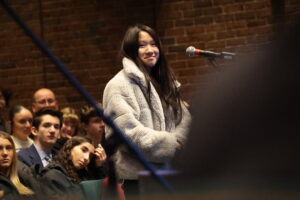
Though her published output is small – two story collections, a novella, and a short novel — Keegan spoke of her work with humility and gratitude. “I’m regarded as someone who isn’t very productive at all,” she said. “But I’m lucky with how many readers my small output has found.” She shared that she doesn’t really know where ideas come from, but it’s more of a feeling that needs to be put into words. She described herself as superstitious about stories. If she ignores one that insists on being written, she believes it may go elsewhere. “If I don’t write them down,” she said, “they’ll go off, and somebody else will write them down.” Writers, she told students, are people who stay. “Writers are people who finish things.” A text, once begun, deserves loyalty.
Keegan does not aim to impress readers, nor to please them at all costs. “Some part of me really doesn’t mind if the reader dislikes it,” she admitted. Writing to please, she suggested, risks dishonesty. Instead, she writes “a book I would like to read.” If she cannot take pleasure in it, she would not expect anyone else to. 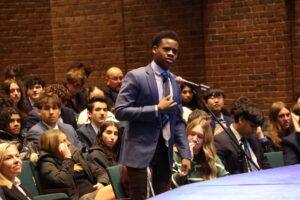
Keegan expresses ambivalence about film adaptations of her work, emphasizing that the written text remains intact regardless of how it is interpreted on screen. With a typically Irish strain of self-deprecation, downplaying her own involvement while ironically acknowledging financial success, she quipped, “It’s something I stay out of… I just cry all the way to the bank.”
Ultimately, Keegan invited students to pay attention to the small moments that unfold and unsettle – the puzzle in Small Things Like These or the wallpaper in Foster. Because, as she reminded the audience, fiction at its best is not about cleverness or noise. It is about “what it means to be alive.”
Arts
News Main News