November 10, 2025
Digging Deeper: History Students Explored Ct’s Untold Stories Through Yale’s Museums
When KO’s AP U.S. History students set out for New Haven on a crisp autumn morning, they weren’t just going on a field trip. They were stepping into history — literally. Guided by history teacher Steph Sperber, the students spent the day visiting three Yale-affiliated museums — the New Haven Museum, the Beinecke Rare Book & Manuscript Library, and the Yale Center for British Art — uncovering the deep and often uncomfortable ties between Connecticut’s past and the system of slavery that shaped America long before the Civil War. “It wasn’t just about learning what happened,” Sperber said. “It was about how it happened, and who has — and hasn’t — been centered in those stories.”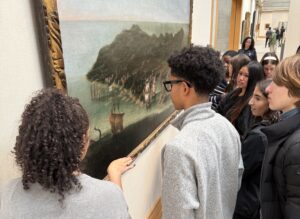
The inspiration for the trip began months earlier, when Sperber was selected for the inaugural cohort of the Yale and Slavery Teachers Institute, an immersive two-week program that brought together 27 educators from across New England to study how abolition and slavery were intertwined with Yale’s history and Connecticut’s social and economic development. “We worked directly with Yale historians like David Blight and Hassan Kwame Jeffries, analyzed original documents, and even traveled to Providence and Newport to explore the regional impact of slavery.”

Each participant was asked to create a publishable lesson plan on the topic. Sperber’s project became a document-based question (DBQ) focused on Black advocacy and community-building in Connecticut before the Civil War. The project laid the groundwork for something much bigger — a way to bring her students into the same conversation.“I realized I could actually do this – I can take my 30 AP kids to these exact sites, where the documents, art, and stories live,” she said. “Their summer reading was about black freedom seeking and agency, and to what extent there was autonomy in colonial New England.”
With the help of the same historians, curators, and educators she met at the Institute, Sperber designed a compressed version of her Yale experience for her AP class. “This was a pilot year,” she said. “We wanted to see how it would go, and it went beautifully.” The students were ready to expand their lens from abstract ideas to tangible evidence. Their central question: How did Black individuals and communities in Connecticut advocate for freedom, education, and equality in the face of systemic resistance? The field trip became a bridge between classroom learning and lived history.
At the New Haven Museum, the students were guided through Amistad Retold, a powerful exhibit revisiting one of Connecticut’s most famous historical events: the Amistad revolt of 1839. Traditionally told as a story of noble abolitionists and legal triumphs, the museum’s reframed exhibit centers instead on the freedom seekers themselves who were rebelling.“Students explored how the story has been told over time — and whose perspectives have dominated those narratives,” Sperber explained. “They looked at 19th-century newspaper articles, propaganda art, and political cartoons that portrayed the Africans alternately as heroes or victims. It opened up questions about bias, power, and the politics of representation.”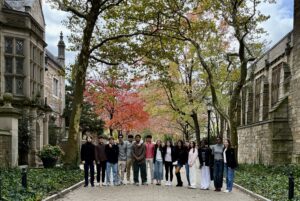
They also learned how Connecticut’s unique status as a dual capital (Hartford and New Haven) linked the Amistad case directly to the state’s power structures. The students left with a deeper understanding of how rebellion, law, and media intersect to shape public memory. If the New Haven Museum challenged how students see history, the Beinecke Rare Book & Manuscript Library made them touch it.
With the help of a Yale archivist, Sperber secured access to original 19th-century newspapers, letters, and meeting records. Students gathered around tables to examine faded ink and decipher the cursive, not an easy task for students who grew up on keyboards.
Among the most powerful pieces was a letter written by Judith Cox, an enslaved woman who had been brought to Ohio, a free state, and was pleading for the freedom of her son, still enslaved in New Haven. “We see these complications over and over,” Sperber said. “so that was really powerful. The students are actually reading those letters, holding the letter that she wrote.”
Students also studied abolitionist newspapers such as The Liberator and The Charter Oak, comparing language, tone, and audience. They noticed “freedom-seeking” advertisements – often labeled “runaway slave” ads – and discussed how even the wording of history can obscure agency.
Another document detailed the failed proposal for a Black college in New Haven in 1831. Despite community fundraising efforts, the vote to establish the school was defeated 700–4. “We talked about the role of education,” she said. “What is the role of the colored people’s conventions?” Although some black students could attend Yale, they were not given grades.” The class also discussed James Pennington, the first black Yale student, who attended the Temple Street Church in Hartford, which spurred a conversation about the role of black churches.
The final stop of the day was the Yale Center for British Art, where students met with curators and conservators to study how art itself has served as both witness and participant in the narrative of slavery. They began with a painting of white men sitting around a table smoking, and one small Black boy standing quietly behind them, holding a glass of rum. “Students had seen artist Titus Kaphar’s reinterpretation of that same painting in class,” Sperber said. “Seeing the original in person — and realizing how long that boy’s story went untold hit differently.”
At the end of the day, Sperber asked her students what the experience meant to them. They told her that the visit brings history alive. Although the students researched the materials online, they were struck by the authenticity of the primary sources and engaged on a professional level with research historians.. “They’re having dynamic conversations and asking real questions because it’s not just a teacher,” she said. “It’s someone who has spent their life doing this for a living.”
Sperber hopes to continue offering this trip in future years, expanding it as the Yale and Slavery Institute evolves. The next cohort will focus on Indigenous history and slavery, followed by topics like abolition and the economy.“It’s exciting to think that we can keep building this partnership,” she said. “We’re helping students see history not as something written in stone, but as something still being examined, questioned, and rewritten.”