
October 30, 2025
From Standing Ovations to Standing for Change: Theater Producer Tony Montenieri ’96
Sitting in front of the massive stone fireplace at the Campbell Apartment, a cocktail lounge nestled inside Grand Central Terminal, amid luxurious velvet and leather seating, deep mahogany tables, and a looming 25-foot ceiling, provides the perfect reprieve from January’s head-down, wind-off-the-river squall, coursing the avenues and blowing up gritstorms. The space feels simultaneously grand yet cozy. Although it’s no longer a secret, The Campbell still retains that particular New York in-the-know feeling, a perfect meeting place to speak with executive producer of Lotus Productions, theater insider, and civic organizer Tony Montenieri ’96, who shared the behind-the-scenes mystique and allure of the theater and the intersection of art and social activism.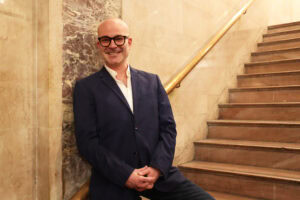
Montenieri rushes in, face flushed, and removes his wool hat, exposing his smooth, clean-shaven head, which gives him more than a passing resemblance to Stanley Tucci. With his wide, easy smile, he describes his early days in New York City with charm and self-effacement, radiating warmth and intelligence that make him instantly likable. His landing in the City reads like a script from an endless list of plays – A Chorus Line, Sweet Charity, 42nd Street, Bullets Over Broadway, and Funny Girl, to name a few – whose dog-eared subject is the small-town idealist’s desire to break into theater. It’s the New York full of possibilities – something extraordinary could happen at any minute.
“It’s a total cliche,” Montenieri laughs. “Two days after I graduated from Skidmore, I showed up with two suitcases and a couple of bucks in my pocket, slept on a couch for a month until I could find the most disgusting apartment. When my parents saw the apartment for the first time, my mother cried all the way home.”
Enduring his vertiginous climb to his fifth-floor apartment and a meager $300-a-week paycheck, Montenieri found a band of fellow artists all seeking their shot. Disregarding the hardships, he never wavered and never considered moving home. To keep his skills fresh and his bank account full, he sublet his apartment and toured the summer stock circuit, performing with American Family Theater and the Gateway Playhouse, to name a few.
After a string of near-miss auditions, he reached an existential crossroads by the time he was 25 years old. Taking stock of his situation, he realized that in moments when he relaxed and cared less, job offers appeared. So, he took a break from the grind of auditions. “I thought maybe if I could assist someone in the theater,” he said, “they’ll give me some direction and an open door.” Circling an ad for a job as an assistant to a playwright, activist, and performer, he recognized that the contact listed on the ad was a woman he’d attended college with. She set up the interview with V, formerly Eve Ensler, the writer of the breakthrough play The Vagina Monologues, which was closing its off-Broadway run after five years. Montenieri nailed the interview and got the job.
As an aficionado of musicals, Montenieri viewed most theater as entertainment. His introduction to V and The Vagina Monologues completely altered his perspective on the transformative power of theater. The Vagina Monologues is a collection of monologues based on interviews Ensler conducted with over 200 women, exploring their experiences with sexuality, body image, love, rape, childbirth, sexual violence, and empowerment. The raw immediacy of its subject matter broke many taboos at the time. Ensler understood the play’s impact beyond the theater, and in 1998, Ensler founded V-Day, a global activist movement aimed at ending violence against women (cisgender, transgender, and those who hold fluid identities that are subject to gender-based violence,) girls, and the Earth. Proceeds from performances of the play often go toward local organizations that combat domestic violence and sexual assault. Alongside being executive producer of Lotus Productions, V’s commercial production company, Montenieri now serves as campaigns director and event producer for V-Day. 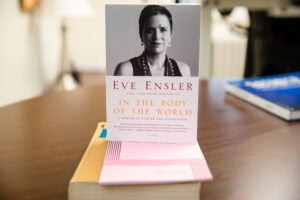
A deeply reflective person, Montenieri discusses his experience with the play and the organization as his trim frame settles further in the leather seat. His expressive eyes flash with excitement or lower in quiet contemplation. He explained that, although he was familiar with the play as a cause celebre, he wasn’t fully aware of the depth of its impact until he began to work with Ensler. On his first day, the V-Day team suggested he watch Until the Violence Stops, the first documentary of the V-Day movement, which was in the process of being edited. He was moved by what he saw.
“Art is so powerful,” he said. “What I learned very early on through The Vagina Monologues is the power of theater to heal people who have suffered abuse and sexual violence. It was an awakening.”
Montenieri said that in the lead-up to V-Day at that time, regional empowerment workshops are conducted on each coast and in Europe, where activists gather and discuss the issues they’re confronting in their communities. Early on, while attending one workshop, Montenieri was paired with a Bosnian woman who shared the brutality of a rape camp to which she and her mother had been taken.
“I was thinking, while she was experiencing this horror, ‘What was I doing in 1993 and 1994?’,” he said. “I pictured myself in a KO school assembly. That moment changed my life. It broke open my consciousness of my privilege.”
The Bosnian woman explained how she had performed and produced the play and how the process healed her. Through this exchange, Montenieri said he started to “get it” and began to understand the profound impact of theater. “I don’t think I ever looked at theater that way until this point in my life,” he said.
Through his senior position in the non-profit, Montenieri has heard his share of traumatizing stories that could readily spill over and disrupt one’s own mental health. His friends and partner ground him. “It’s about making sure that there’s a line where you know you’re doing your job and you’re doing all you can do,” he said. “I try to understand what is mine to hold, and what is not, and how to separate the two.”
In 2016, Montenieri produced In the Body of the World at the American Repertory Theater at Harvard University and then off-Broadway at the Manhattan Theater Club, a play adapted from V’s best-selling memoir under the same name about her battle with stage-4 uterine cancer. He regards this work as the most personal to him because he was with V when she received her diagnosis and then spent the next 10 months with her at the Mayo Clinic and in New York City on her journey to healing. As one of her go-to people, Montenieri was the inspiration for one character in the play. “That play was a love song to every single person in her life who was on that journey with her,” he said. “She has the biggest heart of anyone I know.”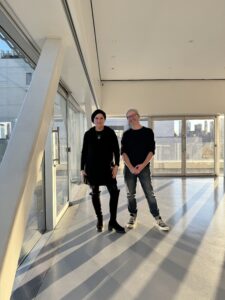
Montenieri is currently involved in a one-night-only musical uprising, Dear Everything, a narrated concert about climate change and collective action. What could easily become a pedantic work, Dear Everything is written instead in a manner that opens the door for people to explore very heavy topics, Montenieri said. “It’s inspiring,” he said. “It gets you ramped up so you’re ready to jump in. That is the kind of theater that is important when discussing social justice and activism.”
Montenieri was active in the KO theater department as a student, playing Daddy Warbucks in Annie (wearing a latex cap to make him look bald) as a junior, and Billy in Anything Goes in his senior year, and participating in all the musicals. He lists several KO teachers who cultivated his interest in music and theater, such as former orchestra conductor Rich Chiarappa, former theater director Lud Baldwin, and former music teacher Wayne Pierce and his wife, Barbara, his voice teacher at the time. His former French teacher, Joan Edwards, also recognized his interest in activism and encouraged it.
Kingswood Oxford’s theater department has evolved greatly since Montenieri walked the boards in Roberts. In 2024, he saw the KO production of A Chorus Line, and was moved to tears by the end of the show. He was overcome, he said, by the emotional weight of his experience at KO, memories of his times spent in the theater, and the level of excellence in the performance. During the intermission, he ran into former tech director Mark Kraviez and KO classmate and current Director of College Counseling Jami Silver.
“I was so proud of the theater education and preparation Kyle Reynolds (KO’s performing arts chair) is giving these students,” he said. “I’m proud of my education. My gratitude is just so deep, and my pride is exploding in me. While watching the audition number in A Chorus Line, I thought, ‘The level of talent – it’s incredible.”
Montenieri advises theater students to broaden their horizons and not be confined only to just the theater. You have to be students of the world,” he said. “because only then can you understand the part you are trying to play.”
Theater as a platform for activism is not new, of course. Brechtian agitprop theater in the 1930s and 1940s, for instance, was intended to make audiences think and to inspire political and social action. Even Shakespeare grappled with political matters in his history plays. Oftentimes, theater is a productive channel for helping people engage with subjects that can sometimes be uncomfortable to address. Montenieri feels theater peels back layers, helping us understand the human condition more fully.
“Here’s what you need to know about changing the world,” Montenieri said. “It’s always going to need changing. We open these doors for people to identify how they want to identify, or we look at the history of intersectionality of race and gender. Theater keeps opening doors, inviting people in, and we need to keep up.”
News Main News