
April 07, 2026
Holocaust Survivor Speaks at Assembly
Each year, the number of Holocaust survivors dwindles, so when the opportunity to hear a firsthand account of the Nazi atrocities arises, you take it. Holocaust survivor Rabbi Lazowski spoke to our community about his experience as a young Jewish boy in Poland in the 1940s. The rabbi was joined by his son, Alan Lazowski P’12, and Suzanne Pinkes P’14, ’20, who helped write his recent book, Transforming Darkness into Light. Our students, Adam Gold, Julia Antansio-Villa, and Charlie Levin, moderated the panel.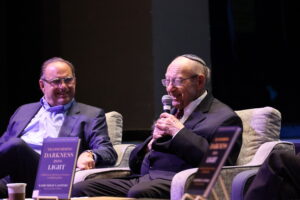
Alan Lazowski shared his father’s story. He began by describing his childhood in a small village in Poland, where Jewish and non-Jewish families lived harmoniously alongside one another, and life felt stable and familiar. Then, in 1941, everything changed. The Nazis arrived. Homes were burned. Families were forced from their lives and into a ghetto. People were separated, sorted, and killed, many times in front of their own community. Survival often came down to chance. The lucky ones carried documents stating they were doctors or nurses, professions the Nazis could exploit.
One day, while in the ghetto, Rabbi Laz found himself in one of those selection lines. He described watching people being divided into those who might live and those who would not. Knowing he would not survive on his own, he began asking strangers to claim him as their child. One woman, a nurse, holding her two daughters, agreed. She didn’t know him, but she took his hand anyway, and that decision saved his life.
Later, during the final days of the ghetto, Rabbi Laz was with his mother and siblings in a movie theater where people were being held before execution. His father had already escaped. His mother understood what was coming. She told him he needed to live. Then she broke a window, pushed him out, and stayed behind with her younger children.
He didn’t want to go, but she insisted, and before he left, she gave him one responsibility: survive and tell people what happened. Although a Nazi soldier who was standing sentry saw the young boy, he turned his head and pretended not to notice. The rabbi escaped with another boy who was similarly pushed out a window. The rabbi found his father and brother in the woods, where they lived for two years, dealing with freezing temperatures, hunger, illness, and constant danger.
After the war, he came to the United States with almost nothing – no money and no knowledge of English. He worked early mornings, went to school during the day, and built a life from the ground up. By chance, he was at a party and overheard the story of a young nurse in Poland who saved a boy in a selection line. He said to those at the party, “I am that boy.” In a remarkable twist of fate, he connected with the woman who was then living in Hartford and married her daughter.
Our students led the conversation and asked thoughtful, direct questions about his childhood, his survival, and what it means to carry a story like this forward. Pinkes explained that survivors don’t tell these stories because it’s easy. Many chose not to speak about their experiences at all. Those who do are choosing to share something difficult because they believe people need to hear it. She also explained the concept of the book they co-wrote: making meaning from the Rabbi’s stories so people could learn from them. The book is organized into eight thematic areas: faith, education, history, community building, courage, and others. Each section of the book starts with a story from the Rabbi’s life and uses that story to tease out these lessons.
For example, when his mother tossed him out the window, she said, “You need to tell the world what’s happening here.” And the book uses that story to say, “The world needs to understand history. We all need to understand history because that’s the only way we prevent atrocities from happening again.” His mother understood that on some deep level,” Pinkes said, ” in order to prevent the horrible things that hatred can lead to, we need to understand them at the very earliest days and prevent them from escalating into mass murder like the Holocaust.”
Rabbi Laz didn’t present himself as a hero. In fact, he made a point of saying he was there not as a rabbi, but as a survivor. His message was simple: life can be difficult, but you keep going. You learn. You don’t give up. And you make choices that move things in a better direction.