
January 28, 2026
How KO Is Adapting to the Age of Artificial Intelligence
Artificial Intelligence (AI) is rapidly reshaping education, creativity, and the workplace. From writing support to image generation and personalized feedback, AI tools are becoming increasingly accessible to students and teachers alike. Recognizing the importance of preparing its community thoughtfully and responsibly, KO has taken a proactive, research-based approach to integrating AI into teaching and learning.
Rather than reacting to emerging technologies, KO has chosen to lead with intention, ethics, and education spearheaded by Upper School English teachers Dr. Jennifer Hayman-Gross, chair of the AI working group, and Heidi Hojnicki, director of teaching and learning.
Hayman-Gross and Hojnicki launched the faculty AI working groups after attending a workshop on artificial intelligence over two years ago to responsibly address this emerging technology. As lifelong learners, many faculty were eager to explore the tool to identify and practice using AI professionally and in the classroom. In the first year of discovery, 22 faculty and staff members, split into five cohorts, met monthly and collaboratively explored uses and offered professional development workshops on lesson planning, administrative tasks, assessment, AI literacy, and curriculum use. The Lead Learners from each cohort prepared two-hour professional development workshops for the faculty, first explaining the main concepts and then allowing the participants to explore the platforms. The topics included: AI Tools to Create Images, Teaching AI Literacy Across Disciplines, Cheating Rubrics Using AI, Crafting Effective AI Promots and Using AI for Assessment and Feedback. 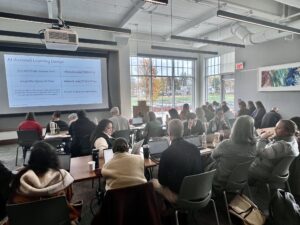
Following the workshops, the working groups surveyed participants about what they learned in each session, as well as cohort members about what they enjoyed about participating in the group. After processing the data, Hayman Gross and Hojnicki could recognize KO’s strengths and areas for improvement. In June of 2025, they presented their findings at Loomis Chaffee’s “AI Symposium: Mining the Mind.”
Recognizing that AI is only going to become more powerful and nuanced, KO is having policy conversations and developing a statement on AI use and an AI Use scale – a zero to three scale that describes the level of AI for schoolwork. Zero represents no AI use to show the student’s independent thinking; Three represents using AI to stretch thinking, explore perspectives, and enhance research while staying transparent.
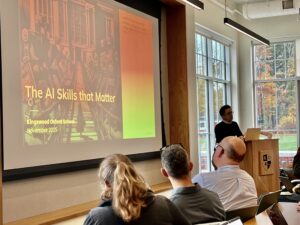
This November, Eric Hudson, an educational consultant who specializes in artificial intelligence. presented at a professional development workshop at KO entitled “The AI Skills that Matter,” asking the faculty: “What is the job of schools in a world where generative AI is present. The answer: “To anticipate and shape the future.” To do this, he recommends these skills: extending the mind, information literacy, playfulness, and ethical decision-making. Regarding adapting assessments, Hudson suggests focusing on the process, adopting AI-resistant strategies (hands-on project work, in-class work), adopting AI-assisted strategies, and fostering AI-aware design.
Moving forward, Hayman-Gross and Hojnicki will conduct student focus groups, research AI literacy at peer schools, and recommend ways to integrate AI instruction into our health and wellness curriculum. Ultimately, KO’s goal is to teach the effective and ethical use of AI. The key takeaway? AI should not be viewed as a substitute for a student’s thinking, judgment, or creativity but rather as a tool that strengthens their existing skills. Throughout the process of grappling with an emerging technology, one thing remains clear: there is no replacing the care and attention of KO teachers working one-on-one with our students.
Thinkers
Blog Main News