
April 14, 2026
Middle Schoolers Learn About Aquaculture Careers
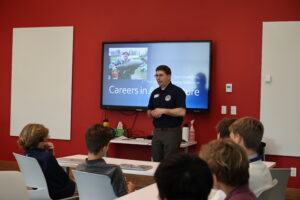
In the Middle School Aquaculture Skills Incubator, learning comes to life through real-world voices.
Recently, students had the opportunity to hear from a state aquaculture expert, Tom Chairvolotti, whose career quite literally flows through Connecticut’s waterways. As the person responsible for overseeing all three state fish hatcheries—and serving as Connecticut’s fish pathologist, his work blends science, environmental stewardship, and public service.
Speaking candidly to students, he described his role not in terms of title, but purpose: serving the public by ensuring healthy fish populations across the state. From testing fish health in a lab to managing hatcheries that raise hundreds of thousands of trout each year, his work touches ecosystems—and anglers—across Connecticut.
Chairvolotti’s path was shaped by curiosity, hands-on experience, and what he described as a willingness to “keep learning.” Starting with long days feeding fish, sometimes 12 hours straight, he developed a deep understanding of animal behavior simply by observing, adjusting, and sticking with it. “If you like something, you’ll learn it,” he said. “And if you keep at it, you’ll get good at it.
The visit tied directly into students’ work in the aquaculture incubator, where they are exploring ecosystems, biology, and environmental systems through hands-on learning. Using accessible examples, he broke down complex concepts: the difference between cold, cool, and warm-water fish; why water temperature determines where fish can live; and how hatcheries “stock” fish into public waterways. He explained that 50% of the seafood we eat is farm-raised, making aquaculture essential to global food systems.
One of the most fascinating moments came when he described the life cycle of fish, particularly salmon. A single egg, no larger than a pinhead, contains enough information to guide a fish across oceans and back to the exact stream where it was born. For students, it was a powerful reminder of the complexity of the natural world and the vastness of what remains to be discovered.
He also shared how hatcheries operate: Raising fish from eggs (called broodstock), monitoring water quality through advanced filtration systems, using both traditional raceways and modern circular tanks, and even employing techniques like electrofishing (for research purposes only) to safely collect fish in the wild
While the science was compelling, the bigger takeaway was about learning itself. He spoke honestly about missed opportunities, those times he didn’t fully pay attention in school and had to relearn concepts later in his career. He also encouraged students to think ahead—exploring careers early, building skills from hobbies, and finding ways to stand out in competitive fields.
Experiences like this are exactly what define the Skills Incubator program and the broader KO approach. Students aren’t just studying science. They’re meeting professionals in the field and connecting classroom concepts to real careers. It’s learning that is active, relevant, and deeply human.