
January 20, 2026
Mock Trial Team Advances in Competition
KO’s Mock Trial program brought two teams – one veteran and one novice – to a regional mock trial competition in December, marking the culmination of months of preparation, collaboration, and intensive legal analysis. Facing schools from across Connecticut, students argued both sides of a challenging criminal case and demonstrated the confidence, adaptability, and teamwork that define the program.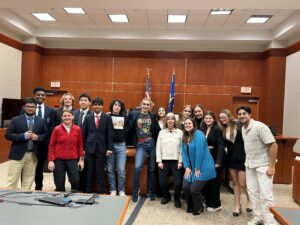
The veteran team, composed largely of experienced mock trial students with a few newer members, delivered a standout performance, winning both their prosecution and defense trials. In mock trial competition, teams must win both sides of the case in order to advance, and the veteran team’s success earned them a place in the next round of competition in February.
The novice team, made up almost entirely of students participating in mock trial for the first time, also impressed judges and coaches alike. While they did not advance, they won one of their two trials—an accomplishment that speaks to both their preparation and potential. For a team of mostly first-year participants, the result was a strong and encouraging start.
The case, which students received in mid-September, centers on a charge of second-degree manslaughter involving an alleged accidental opioid overdose. Students worked with the same case from September through the December regional competition and will continue refining their arguments and performances as they prepare for the February round.
Mock trial cases are intentionally crafted so that either side can win if argued effectively. Students must digest extensive materials including witness affidavits, medical reports, exhibits, photographs, and timelines. From there, they develop legal theories, identify key evidence, and decide how best to tell a compelling and legally sound story.
Each team prepares both a prosecution and a defense, complete with student attorneys and witnesses on each side. Attorneys write opening and closing statements, prepare direct and cross-examination questions, make objections, and respond to opposing counsel in real time. Witnesses memorize lengthy affidavits and must remain fully in character while answering unpredictable and often aggressive cross-examination questions, all while staying true to the facts of the case. Because teams must compete on both sides of the same case, students are required to understand the material deeply and flexibly. Success depends not only on memorization, but on analysis, improvisation, and the ability to pivot strategies live in front of judges who may be unfamiliar with the case.
KO’s Mock Trial teams meet once a week, making the level of preparation and success particularly notable. According to faculty advisor Rachel Heffner-Burns, the program gives students the opportunity to develop a wide range of transferable skills over a sustained period of time.“I hope they have more confidence in their public speaking skills, in their ability to do research, to close read something and analyze it,” Burns said. “They really start to think about the power of language, not just what we say, but how we say it.”
Heffner-Burns emphasized that much of mock trial, like real law, comes down to storytelling within clearly defined rules. “So much of how cases are won and lost is the way you frame a question, the way you answer a question, and the way you communicate a story,” she explained. “You have to do all of that within certain parameters in order for it to be permitted.”
Beyond individual skill development, Heffner-Burns highlighted the collaborative nature of the work. “So much of the fun they’re having comes from working with each other,” she said. “They’re writing together, rehearsing together, fine-tuning questions, and really getting to the root of what they want to emphasize.” She likened the experience to a live performance, noting, “It feels like a piece of theater but with stakes. They get the energy of performing live, while also knowing that the work they’ve put in over months really matters.”
The teams are coached by Heffner-Burns, along with Lynn Levine, a retired faculty member and longtime mock trial advisor whose teams saw notable success during her tenure, and Melinda Rose P’21,’26, a practicing attorney. Together, they guide students through the competition’s legal, analytical, and performance-based elements.
Heffner-Burns praised the students’ commitment and passion, noting that mock trial requires sustained focus rather than short-term preparation. “This isn’t something you study for, and then it’s over,” she said. “It’s sustained work—an hour and a half every week, over months—where students learn that they can take on something complex and do it well.”
As the veteran team prepares for the February competition and the novice team builds on a strong first season, Heffner-Burns expressed her pride and excitement for what lies ahead. “They’ve put in the time,” she said. “They are incredibly talented, brilliant, and hardworking. I just want them to have their moment to shine in the playoffs, because they truly deserve it.”
With strong leadership, dedicated coaching, and a growing pipeline of talented younger students, KO Mock Trial remains a program where students challenge themselves, collaborate deeply, and gain skills that will serve them well beyond the courtroom.