
February 03, 2026
Remaking Our Rivers: Boyce Upholt at the Stroud Science Symposium
At this year’s Stroud Science Symposium, students had the opportunity to hear from journalist and author Boyce Upholt, whose work explores one of the most powerful forces shaping both our landscape and our lives: rivers. Upholt, a West Hartford native and the author of The Great River: The Making and Unmaking of the Mississippi, spoke about how humans have reshaped waterways—and what those changes mean for the future, both globally and right here in Connecticut.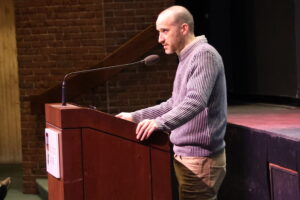
Science Chair Graham Hegeman opened the assembly by emphasizing that meaningful scientific impact does not always begin in a laboratory. He reflected on the origins of the Stroud Water Research Center, which was founded in 1966 by two non-scientists who believed that careful observation and long-term study of streams could make a difference. That same spirit—paying attention to water and learning from it—guided Upholt’s own journey as a writer and thinker.
Although Upholt’s father and grandfather were scientists, he chose storytelling to engage with science. After earning degrees from Haverford College and Warren Wilson College, he joined Teach for America and moved to the Mississippi Delta. Living in that floodplain landscape changed how he understood rivers, not as simple lines on a map, but as vast, living systems shaped by history, engineering, and culture.
Initially, Upholt didn’t focus on the environmental aspects of the Mississippi River and Delta; rather, he wrote about it as a rich cultural center, laden with the history of sharecroppers and music. One of the reasons Upholdt failed to engage with the river is that it is virtually “invisible” from its banks. The height of the levees obstructs one’s view of the river. “You could live here for six years as I did,” he said, “and not think about the river that is so important to the landscape.” All that changed when a magazine assigned Upholdt to write a profile of John Rusty, a modern-day Huck Finn who takes tourists canoeing on the river. Upholt’s three-day canoe trip with Rusty was a revelation. “I didn’t think the Mississippi would be beautiful, and then I got out there, and it was,” he said. “There were forests and sandbars and islands with foot tracks of coyote and deer.”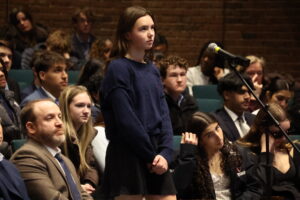
Continuing his own exploration of the Mississippi eventually led to the writing of The Great River, a book that traces how the United States has sought to control the Mississippi River through levees, dams, straightening, and channelization. Upholt explained that these engineering efforts were often motivated by good intentions, protecting communities from floods, supporting agriculture, and enabling shipping, but they also produced unintended ecological consequences. By confining rivers to narrow channels and cutting them off from their floodplains, humans have made river systems less resilient and more prone to catastrophic flooding when those systems fail .
A central idea of Upholt’s talk was what he called “thinking like a watershed.” A watershed is all the land where rain and snow drain into a shared network of streams and rivers. Rather than seeing a river as a single channel, watershed thinking asks us to recognize that every drop of water, whether it falls in a backyard, a parking lot, or a farm field, connects us to everyone downstream.
To make this concept personal, Upholt turned his attention back home. Students learned that KO is within the Connecticut River watershed, and, more specifically, within the Park River watershed, which includes smaller streams such as Trout Brook, which flows just across the street. Though easy to overlook, Trout Brook played a central role in West Hartford’s development, powering early mills and shaping settlement patterns. Over time, fears of flooding led to the straightening and channelization of the brook, transforming a natural stream into an engineered waterway.
In Hartford, parts of the Park River were eventually entirely buried underground. Upholt described how this “hiding” of rivers makes it easy to forget they exist and even easier to forget our responsibility to them. Stormwater, pollution, and runoff do not disappear when they enter a drain; they continue to move through the watershed, affecting ecosystems and communities far beyond where they began.
Upholt also highlighted the concept of resilience, both in natural systems and in human life. Healthy rivers, he explained, are resilient because they have space to flood, absorb water, and recover. When we eliminate that flexibility by building levees, paving floodplains, or forcing rivers into straight lines, we create systems that may function well for a time but fail dramatically under stress.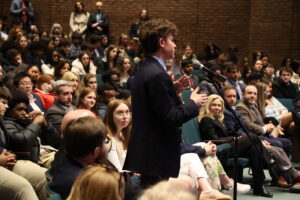
He encouraged students to begin watershed thinking not through grand solutions, but through observation. Walk along Trout Brook. Notice where water flows after a rainstorm. Ask where it comes from and where it goes. By making hidden waterways visible again, we can better understand our place within the landscape and our role in shaping its future.
Upholt’s visit reminded students that rivers are not just distant or abstract features. They are active forces, shaping towns, histories, and ecosystems. By learning to think like a watershed, we gain a deeper sense of responsibility for our local streams, for communities downstream, and for the interconnected world we all share.