
December 04, 2025
A Day of Living History at Old Sturbridge Village
Last week, the entire Form 5 class, joined by several sophomores from the AP® U.S. History course, set out on a journey that blurred the line between the past and the present. Their destination was Old Sturbridge Village, a living history museum in Massachusetts that recreates everyday life in rural New England during the early 19th century.
This trip followed the class’s recent visit to Yale University in New Haven, where they explored history through artifacts, documents, and exhibits. But while Yale offered an experience of history within polished glass cases, Sturbridge presented a more immersive, hands-on encounter — one where the entire village became the museum.
“It’s a really different kind of history trip,” Upper School history teacher Steph Sperber explained. “Yale is a museum that shows you objects and tells you about the past, but Sturbridge lets you live in it for a few hours. You can walk into a blacksmith’s shop, talk to a farmer, or sit in a town meeting. It’s like stepping into another world.”
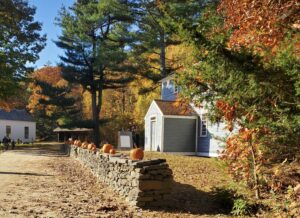
Old Sturbridge Village is a carefully curated reconstruction of real buildings, farms, and workshops from 1790 to 1850. The museum began as a preservation effort, moving endangered historical structures from around New England to a single site. Over the years, it has grown into one of the largest living history museums in the country, with over 40 original buildings, including a schoolhouse, bank, church, general store, and working farms.
Some buildings were built directly on-site using period-accurate tools and techniques, such as the cabinetmaking shop and the piggery. Others were relocated from nearby towns — entire houses carefully disassembled and reassembled, beam by beam. Together, they form a living, breathing village where the sights, sounds, and even smells of the early 19th century surround every visitor.
“Most of the buildings are either original to the town or moved from across New England,” Sperber said. “Each one has its own story and connects students to real people who lived in this region almost two centuries ago.”
Before setting foot in Sturbridge, each student received a family profile — a fascinating document based on historical records from around 1827. These profiles, containing tax information, occupations, family members, and land holdings, came from authentic sources once used by a teacher who first developed the activity over two decades ago. Each student was assigned a historical persona, a farmer, a widow, a tradesman, free Black and encouraged to step into that character’s shoes for the day.
“It’s not just about observing history,” Sperber said. “It’s about imagining yourself as part of it. You have to think about what your life would be like, what decisions you’d face, and what challenges you’d have in that time period.”
This activity is deeply connected with the course’s broader curriculum, which explores life in New England after the American Revolution and leading up to the Civil War — a period defined by industrialization, community building, and social change.
The centerpiece of the day was a reenactment of the town meeting, a tradition that forms the heart of New England’s democratic heritage. In the meeting house, surrounded by students and people in period costumes, the class debated a real issue that towns like Sturbridge once faced: how to care for the growing population of poor citizens during the early stages of industrialization.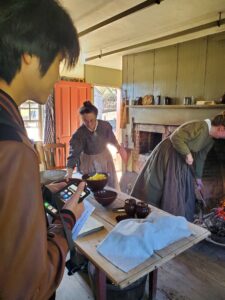
The students had three options to consider:
-
Continue the system of “bidding out” the poor to families who could house and feed them for the lowest price,
-
Raise taxes to fund a communal poor farm, or
-
Form a committee to oversee such a farm and manage resources.
After hearing impassioned speeches and debating as their assigned historical characters, the students voted and reached the same decision that the real Sturbridge townspeople made in the 1830s: to raise taxes, build a poor farm, and appoint a committee to manage it.
“It’s participatory democracy in its truest form,” Sperber said.“Students aren’t just learning about civic engagement — they’re practicing it. And the fact that their vote matched the actual historical outcome made it even more meaningful.”
When the students weren’t debating 19th-century social policy, they roamed the village freely — chatting with costumed interpreters, playing traditional games, visiting the blacksmith’s forge, and interacting with animals in the barns and pastures. The blacksmith’s shop, always a favorite, drew curious crowds, and the village animals, including the pigs, sheep, and oxen, were another hit. Some tried their hand at hoop-and-stick games, others peered into the two-seater outhouse (to much laughter), and everyone appreciated the homemade cookies and root beer from the village bakery.
“It’s amazing to watch even the kids who say they don’t like history come alive,” Sperber said. “They’re laughing, touching, asking questions, and genuinely curious. It’s not about memorizing dates — it’s about understanding people.”
For Sperber, who organized the trip, the day carried a personal touch. She first encountered the “family profile” project as a high school student herself, learning from her former West Hartford history teacher, Liz Divine. Years later, when she became a teacher, Divine passed her the original paper files, which Sperber digitized and continues to use today. “It’s meaningful to continue her legacy in this way,” she shared. “I love that these activities still work — they connect generations of students and teachers through shared curiosity about the past.”
In the weeks ahead, the class will continue exploring the themes that came alive during the trip: industrialization, social responsibility, and the development of American identity.