
January 22, 2026
Honoring Dr. King Through Action: Speaker Inspires Students to Address Food Insecurity
The KO community gathered in Roberts Theater to honor Martin Luther King Jr.’s legacy for an assembly rooted in both reflection and responsibility. First, the Middle School Cantible choir set the tone with an inspiring song by Rollo Dilworth, “The Voice of the Dove,” sung in a Kenyan dialect. Following the performance, the Director of Diversity, Inclusion, and Belonging, Rich Mutts, reminded students that honoring “fierce truth teller” Dr. King means more than remembering his words; it means grappling with the truths he spoke and the work he left unfinished. Quoting Dr. King’s Nobel Peace Prize address, Mutts emphasized King’s belief that “the richest country in the world should not have people going hungry.” Mutts repeated the phrase twice, underscoring that justice, dignity, and equality cannot exist where basic needs go unmet.
Form 2 student Bernie Tottsmann spoke about her awareness of food insecurity and food deserts through her exposure to the issue in her Skills Incubator class. After visiting the local food bank, Loaves and Fishes, she and her classmates organized a drive and filled two SUVs with food headed to the bank. “I learned that a small act of kindness,” she said, “can have a big impact on a community.” 
Then, as part of the Conrad Family Speaker Series, KO welcomed community advocate and philanthropic strategist Nailah-Ricco Brown, whose work centers on food insecurity, dignity, and systemic change. Brown began by naming a reality often overlooked: hunger is not always visible. “Food insecurity doesn’t always look like hunger,” she explained. “More often, it shows up quietly, affecting people’s health, their ability to focus and learn, and how they move through their day.”
Drawing on her professional experience, Brown emphasized that food insecurity is not a personal failure, but a systemic one. “These are not failures of character,” she told students. “They are failures of systems, and all systems can be changed.” In Connecticut alone, she noted, nearly one in seven people experience food insecurity, a statistic that challenged assumptions about where hunger exists and who it affects .
A central theme of Brown’s remarks was dignity. She urged students to think beyond short-term solutions and consider what it means for people to have agency and choice. “What you want is not just to give food,” she said, “but to create opportunities for people to choose, to shop, to identify what is culturally relevant to them. That’s something many of us take for granted.” For instance, rather than donating food, she said, an individual could donate a gift card so people can purchase foods that are culturally important to them. Brown explained that dignity and choice are often the first things taken from marginalized communities, and that restoring them must be part of any lasting solution.
Brown also spoke directly to students about their power to lead and influence change, reminding them that age has never been a barrier to impact. Referencing Dr. King, 12-year-old Freeman Hrabowski, who organized the Birmingham Children’s Crusade, and 15-year-old Claudette Colvin, who refused to sit on the back of the bus, she told students, “You don’t have to have all the answers to make a difference. Learning, asking questions, and listening carefully are powerful starting points.” She encouraged students to see activism as a process, one that grows as they develop new skills, interests, and confidence over time.
The assembly came alive during an extended Q&A, as students asked thoughtful questions about food deserts, access to clean water, protests, volunteering, and civic engagement. In response to one student, Brown emphasized the importance of systems thinking: “When you can’t beat the boogeyman in the room, you can change the system and you can undo the byproduct of the system.” She encouraged students to write to elected officials, volunteer locally, and stay engaged in ways that feel meaningful and sustainable.

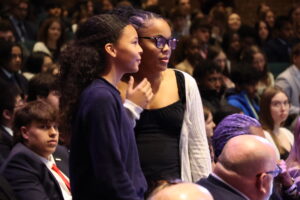

As the discussion concluded, one question lingered, echoing both Dr. King’s legacy and Brown’s call to action: What responsibility do we have to one another? Brown’s answer was clear. Change begins with curiosity, compassion, and the courage to stay engaged. “I believe in you,” she told students. “And I’m counting on you because we need you.”