
January 15, 2026
Leadership Lab Presentations: Reflections on Growth
As part of the Leadership Lab class, students concluded the semester with Presentations of Learning that asked them to reflect deeply on who they are as leaders, how they have grown, and how they hope to make an impact moving forward. Two student presentations, in particular, highlighted leadership not as a position, but as a daily practice rooted in service, reflection, and action.
Both students structured their presentations around guiding questions posed throughout the course, including: Who am I as a leader now? Who do I want to be in the future? How do leaders serve their communities and collaborate with others? These prompts encouraged students to connect theory with lived experience.
The first student, Brooke Bisaillon ’29, shared a leadership portfolio that captured her learning across the semester. “This was a really fun project to do because we were able to demonstrate our learning from the entire class,” she explained. Central to her reflection was the idea that leadership takes many forms and does not rely on authority or titles. “I’m the type of leader that is able to take initiative on projects, build relationships with others to reach our goal, as well as a leader who follows through on commitments,” Bisaillon said. “When something needs to be done, I do it.”
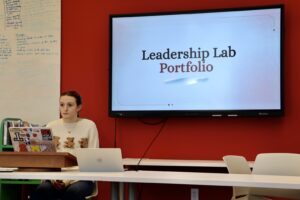
She connected this belief to her exploration of servant leadership, a style that emphasizes supporting others and prioritizing group success. Community-based experiences, such as visiting Loaves and Fishes, prompted her group to organize school-based food drives. The group called local grocery stores to donate food and tasked each form to bring in specific food items. “I felt very informed on my mission,” she said.”This allowed me to feel much more connected to the project.” While at Loaves and Fishes, she also observed that leadership exists at every level. “We saw that everyone there has a different job, and every job is important to the success of the outcome. This showed that every worker had to have leadership qualities.”
Teachers listening to her presentation noticed a consistent emphasis on action and asked her to think ahead: “You’ve talked a lot about action, not just words. What might that action look like going forward?” In response, Bisaillon shared ideas for creating more consistent service opportunities, such as forming a club or offering all students the opportunity to visit Loves and Fishes. “This is something that all students should be able to do,” she said. “Because it’s hands-on, it really offers you a new appreciation and allows you to see what goes on behind these organizations.”
In class, Bisaillon also visited Community First School and worked with students through tutoring and games. One teacher asked her if the Community First experience shifted her thinking and had changed how she views her own classes. “It showed me what teachers really do for you, always putting their students first,” she said. “It connects me even more to my advisor, who is always doing the best for me.”
The second student, Charlotte Gruber ’29, began her presentation by describing the kind of leader she hopes to be. “As someone who is becoming a leader, I want to be one with an open mind and an open heart,” she shared. Drawing from class resources, she emphasized the importance of identity, trust, and creating environments where people feel safe to take risks and share ideas.
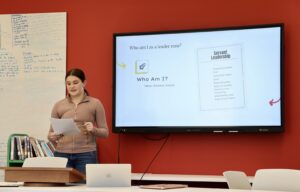
Like her peer, she connected strongly with servant leadership. “Servant leaders always put the team first,” she explained, noting that mentoring, listening, and adapting are just as important as results. Over the course of the semester, she noticed her understanding of leadership evolve. “I used to think I just led with purpose,” she reflected, “but now I value honesty, trust, and having an open workspace to bounce ideas off each other.”
Her learning came alive through hands-on projects, particularly working with younger students at a Community First School. She shared how patience, flexibility, and relationship-building became essential leadership skills. When plans needed to change due to time constraints, her group adapted quickly. “This taught me that collaboration and quick thinking are crucial,” she said. Another lesson she learned through the class was the importance of listening to what the community needs rather than imposing on them what you think they need.”When you’re collaborating with others, having multiple ideas and points of view can help ideas flow.”
Gruber also shared her experience teaching hockey skills to younger players, which required patience to keep the group focused and under control. “It taught me there is a time to have fun,” she said, “and a time when you have to focus and get work done.”
Teachers responded by encouraging her to think about leadership in both the short- and long-term. One reminded her that “thinking about the future doesn’t mean ten years from now, it can mean tomorrow.” Another asked, “What support do you need to take the next step?” prompting the student to consider how advisors, peers, and community partnerships could help her continue developing her ideas.
Both students concluded their presentations by reflecting on legacy. Bisaillon said,” I want people to remember me as someone who’s inclusive, helpful, and a good listener and someone who always treated others with respect.” Gruber expressed a desire to be someone who can take charge of a group and step up when needed. “ I want people to see me as a strong leader who has a strong voice,” she said. “I want to be seen as someone who helps people see a clear vision so that they can feel a sense of accomplishment and become leaders themselves.”
Together, these Presentations of Learning captured the heart of the Leadership Lab experience. Through reflection, service, and meaningful dialogue with teachers, both students demonstrated that leadership is not about having all the answers but about listening, learning, and taking thoughtful action in the world around them.