
August 28, 2026
McDonald’s “Displaced” Earns Recognition at New Britain Museum of American Art
Students are accustomed to KO Upper School art teacher Scott McDonald helping them develop their artistic voices. This summer, his own work is receiving recognition: his graphite drawing “Displaced” was selected for Nor’Easter: The 56th Annual Juried Members Exhibition at the New Britain Museum of American Art and earned a Juror’s Choice Award.McDonald is one of just 61 artists selected for the exhibition, which showcases work by emerging and established artists across a range of media. According to McDonald, approximately 700 works were submitted for consideration. Simply being included, he said, would have been meaningful.
“I would have been happy just being in the show,” McDonald said. Receiving a Juror’s Choice Award, he added, “was obviously an honor that I was happy to get.”
This year’s juror is photographer Robert Calafiore, Associate Dean of Finance and Administration at the Hartford Art School at the University of Hartford. Calafiore, whose work has been exhibited nationally and internationally, is particularly known for his long-running exploration of pinhole photography. A few years ago, Calafiore worked directly with KO students through the Goodman Banks Visiting Artists Series, introducing them to his photographic process and the possibilities of creating images with a pinhole camera. Although Calafiore visited KO, McDonald didn’t have an inside track. He explained that the initial jurying process was blind. Calafiore selected the works for the exhibition digitally, without knowing the artists’ identities, and chose the award winners only after seeing the pieces in person at the museum.
For members of the KO community, McDonald’s selection may come as little surprise. Evidence of his talent can be found much closer to home, in the hallways of Seaverns, where his artwork has helped bring KO’s annual Symposium authors and their books to life. McDonald has created many of the striking posters that accompany the school’s Symposium program, translating literary ideas and imagery into visual form. His graphite work inspired by Elizabeth Strout, for example, centers on the humble image of a mason jar. Quiet and spare in its simplicity, the drawing reflects the understated quality and attention to everyday life found in Strout’s writing.
Graphite is also McDonald’s medium of choice. “That’s sort of my wheelhouse,” he said, describing himself as more interested in drawing and value than color. “I prefer to work in black and white.”
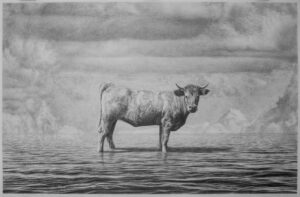
The subject of “Displaced,” a solitary cow standing in water, has personal roots. McDonald had already created a small series of cow drawings, beginning with one he made as a gift for his wife, Katie. As an undergraduate, she spent time creating a photo documentary on a dairy farm, an experience that helped spark their shared fascination with cows as animals “and creatures that we share the earth with.” McDonald eventually decided he wanted to revisit the subject on a much larger scale. At approximately 26 by 40 inches, “Displaced” gave him room not only to render the animal in extraordinary detail, but also to surround it with a vast environment. Earlier cow drawings had focused more tightly on the animal. Here, McDonald wanted “a pretty big open space for the cow to inhabit.” He was particularly drawn to the patterning of this cow’s hide and worked from photographic references to achieve its realism.
But the composition evolved as he worked. McDonald did not begin with a fully resolved sketch. At various stages, he photographed what he had completed, printed it out, and experimented with possibilities before committing them to the final drawing. “I didn’t have everything all planned out right at the get-go,” he said. “It kind of developed as I got into it.” Eventually, the familiar agricultural image became something much more unsettling: a solitary cow standing amid an expanse of water beneath a turbulent sky.
In his artist’s statement, McDonald describes the drawing as an exploration of “the unsettling intersection of domestic agriculture and environmental vulnerability.” By removing the expected pasture and placing the animal within a rising seascape, he uses the image to consider displacement caused by climate instability and the uncertain future shared by humans, animals and the natural world.
Those concerns are closely connected to how McDonald sees his subject. He hopes viewers will first be struck by the animal itself, “how beautiful this animal is,” and see it as an “exquisite creature.” His concerns about climate change and industrialized animal agriculture (Both McDonald and his wife are vegans) are present in the work, but he isn’t interested in dictating what viewers should think. Instead, the image invites them to look closely and make those connections themselves.
McDonald practiced extraordinary patience when executing the finely wrought detail of “Displaced.” He estimates that he worked on the drawing, on and off, for approximately five years. There were months when he did not touch it; during vacations and summers, he would return to the piece waiting in his studio. The water was particularly demanding, he said. McDonald builds his tonal values by moving through the full spectrum of graphite pencils, from extremely hard pencils that produce pale, silvery marks to softer graphite capable of creating deep darks. In some areas, multiple grades of pencil are layered over one another to fill the minute texture of the paper and create richer, more continuous values.
That painstaking process is also part of what McDonald loves about drawing. Rendering the cow’s patterned hide, hair by hair, can become almost meditative. “The making of that is very meditative, just getting lost in it,” he said. He often listens to music or podcasts as he draws, although the slow pace can sometimes be daunting: after working for several hours, he may have completed only a tiny section.
That process gives additional meaning to McDonald’s artist statement, in which he describes the “meticulous, labor-intensive nature” of graphite as mirroring the patient endurance of the animal itself. Every hair, ripple, and cloud helps transform an ordinary agricultural subject into something monumental.
For an artist who spends much of his professional life helping young people make their own work, having Displaced out in the world carries particular significance. McDonald says he isn’t ready to sell the drawing just yet. After living with it in his studio for years, he had only just completed it when he submitted it to Nor’Easter. For now, he is looking forward to bringing it home when the exhibition closes—and perhaps eventually submitting it to other juried exhibitions.
“It’s always really nice to have your work out in the world,” he said, “where other people can enjoy it and see it.”
For now, the KO community can do just that.
Nor’Easter: The 56th Annual Juried Members Exhibition is on view through September 13, 2026, at the New Britain Museum of American Art.
Artist’s Statement
This large-scale, graphite drawing explores the unsettling intersection of domestic agriculture and environmental vulnerability. This piece strips away the expected rural pasture, stranding a solitary bovine in a vast, atmospheric ocean under a turbulent sky. By placing a highly detailed, grounded bull into an endless, rising seascape, the work visualizes the displacement caused by global climate instability. The heavy, textured clouds and deep water contrast with the solid presence of the animal, highlighting a shared, uncertain future between humanity, our livestock, and the changing natural world.
The meticulous, labor-intensive nature of working with graphite on this scale mimics the slow, patient endurance of the subject itself. Every textured hair, ripple of water, and heavy cloud formation is rendered in precise detail, transforming a familiar agricultural subject into a monument of quiet resilience against an overwhelming, changing world.
Arts
News Main News