
January 07, 2026
Middle School Starts the New Year by Building Healthy Communities
The KO Middle School began the new year on a positive and purposeful note with a powerful workshop focused on creating a respectful, inclusive, and safe community for all students. The session, titled “Building Healthy Communities,” was led by DEIB Director Rich Mutts and centered on cyberbullying, stereotyping, and the role students can play as upstanders rather than bystanders. Mutts was joined by fellow DEIB team members, Middle School teacher Tylon Smith and Upper School counselor Felicia Velez, whose perspectives and experience guided meaningful discussion throughout the session.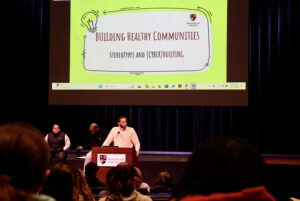
This workshop is part of an ongoing five-part series that Mutts has been facilitating, all with the goal of fostering an environment where everyone feels respected, valued, and safe to be who they authentically are. Mutts said that he feels a sense of belonging when he enters the Middle School. “I feel like I can always be myself around you,” he said. “I’m not afraid to make mistakes. I’m not afraid to mispeak. I can show up as who I am. That is a true testament to what we want the entire school to feel like for everybody.”

The workshop began with a brief review of earlier conversations from the series, revisiting ideas around identity, stereotypes, and what it truly means to belong in a community. One analogy the group discussed about identity was the iceberg metaphor. An iceberg only shows you what’s is on the surafce but not the depth beaneath it. The same is for individuals. We may glean only a small amount of information about a person from appearance; however, there is a wealth of information we don’t see.
Smith shared personal reflections about feeling safe and accepted within the KO Middle School community while a student here. Initially, he felt judged and limited as “just a basketball player,” which led him to feel shut out of the community. Over time, he felt more accepted, but he put in the work. “I had to open my eyes,” he said, “but I also had to help those around me understand where I was coming from. It started with my being open to having that conversation. I opened up and embraced KO for what it was, and I was able to maximize my own experience.”

To introduce the day’s focus on cyberbullying, students watched a short video depicting a girl dancing alone in an auditorium. Unbeknownst to her, someone filmed the moment and posted it on social media. The video quickly spread, drawing hurtful comments and mockery from peers. After viewing the clip, the KO students broke into small discussion groups to reflect on four guiding questions:
Who was the bully?
What actions could be considered bullying?
Did the individuals involved realize they were bullying?
How could someone act as an upstander in this situation?
The discussions prompted thoughtful and honest conversations about intent versus impact, the speed at which harm can spread online, and how easily someone can participate in bullying without fully realizing it. One student felt that taking the video in and of itself was not bullying if the intent was positive. However, Velez felt differently. “I think it’s a violation when the person doesn’t know that you are taking the video. What if they’re not comfortable?”
Students also examined how cyberbullying can feel especially damaging because it is difficult—if not impossible—to undo once something is shared publicly.
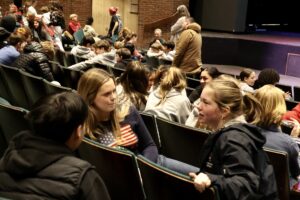
During the full-group debrief, students and facilitators reflected on the importance of using one’s voice, seeking help from trusted adults, and supporting peers who may be harmed. Mutts and the DEIB team emphasized that being an upstander does not always mean confronting a situation loudly or publicly; it can also mean choosing not to share harmful content, speaking privately with a friend, reporting concerns, or checking in with someone who has been hurt.
The workshop reinforced a central message of the “Building Healthy Communities” series: everyone plays a role in shaping the school’s culture. By encouraging empathy, awareness, and action, the session helped students better understand how their choices, both online and offline, can contribute to a community where all members feel safe, respected, and seen. These conversations set a strong foundation for the year ahead and empower students to be thoughtful, compassionate leaders within their community.