November 19, 2026
No Easy Answers: Geography Students Navigate the Art of Compromise
Alison O’Donnell’s Upper Prep Geography class buzzed with energy. Students were out of their seats, huddled around maps, pointing to possible routes, debating their options, and defending their decisions. At first glance, it might have looked a little chaotic. But every conversation had a purpose. The challenge? Design a road through Africa that balances economic development, environmental protection, engineering realities, and local communities’ needs. Sounds simple enough. Until everyone at the table prioritizes something different.
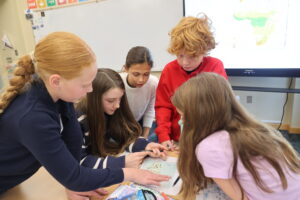
Each student was assigned a role: lead civil engineer, environmental scientist, economic strategist, or humanitarian coordinator. And each brought a different perspective to the project. At one table, a student playing the economic strategist argued for a more direct route because it would cost less. But the group’s environmental scientist pushed back. That land was protected, she explained, because endangered wildlife lived there. Suddenly, the shortest route wasn’t necessarily the best one. And that was precisely the point.
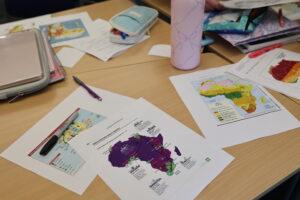
Students had to listen, negotiate, defend their positions, and ultimately find a compromise that addressed competing priorities. They were learning geography, certainly, but they were also discovering how decisions made on a map can have far-reaching consequences for people, economies, and the environment.
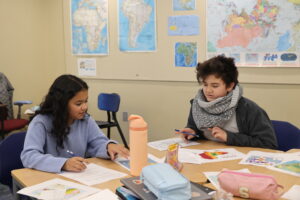
Throughout the class, O’Donnell moved from group to group, observing conversations and asking questions. Rather than telling students where to draw their roads, she challenged them to explain their thinking. “Why are you doing it that way?” “What led you to that decision?”Her approach was encouraging but deliberately open-ended. She reminded students more than once that there wasn’t necessarily a right or wrong answer. Multiple solutions were possible, as long as students could explain the reasoning behind their choices.
For students accustomed to problems with one correct answer, that freedom can be both exciting and a little daunting. Here, success wasn’t about finding the answer in the back of a textbook. It was about weighing evidence, considering alternatives, and making a thoughtful case for a decision. They also recognized that someone else’s priorities could be just as valid as their own.
What stood out was how much of the learning happened between students. They moved around the classroom, leaned over one another’s maps, exchanged ideas, and worked through disagreements. O’Donnell guided and encouraged, but the students did the heavy lifting.
After class, O’Donnell reflected on the room’s energy. “This is what a class should look like: kids walking around, talking to each other, and solving problems together,” she said.
In a single class period, students practiced far more than map reading. They practiced communication, learned to advocate for their ideas, considered perspectives beyond their own, and discovered that compromise doesn’t necessarily mean giving up. Sometimes, it means finding a better solution together.