
November 04, 2025
Raising Livestock and Students: One Teacher with Two Passions
Mother’s Day is a time to show our moms how much we appreciate them with fail-safe gifts, such as flowers and chocolates. But not for Middle School art teacher Katherine Nicholson, owner of the bucolic 17-acre Sand Meadow Farm in Ellington, Conn. Her family gives her something a little different, a little more porcine. “Piglets are the perfect Mother’s Day gift,” she said.“They’re smart and personable.”
Her piglets live the “high life,” she attests, grazing in the pasture, eating a high-quality full-grain diet, and being protected from the elements in a shelter. However, seasons progress, and by October, the pigs, now weighing 270 to 300 pounds each, are stronger than they realize and are ravaging the fencing. Their next stop is Plymouth Meats in Terryville, Conn., for processing, where the company produces pork chops unlike any others.
It’s morning at Sand Meadow, with a light, misty rain hanging in the air and a brisk 54-degree temperature —a too-familiar and unwelcome weather pattern this spring in New England. The air is thick with earthy richness — the pungent tang of manure, the grassy sweetness of hay bales, and the smoky aroma of tobacco from the curing barn, all mingling with the smell of muddy soil.
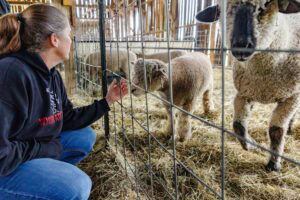
Life is in full swing at the farm. As Jon Nicholson, Katherine’s husband, greets us, so too does Cleo, the Great Pyrenees guard dog who lives with the sheep in the barn 24/7, her tail wagging as steady as a metronome. Clyde, the mischievous black and white cat, loops figure-eights around pant legs, and the ducks wobble-walk by. The lambs, housed in a greenhouse, march in formations, following one another in and out of the structure, acting much like sheep. The pigs are rooting and snuffling from their corrugated feeder, banging the door shut with each mouthful of fodder. Chickens, including the rusty-feathered ISA Browns, are clucking. Alice and Penelope, the cows, are lowing in their corral as Thistle, the red roan calf born over the Easter weekend, looks on cautiously at her mother’s side.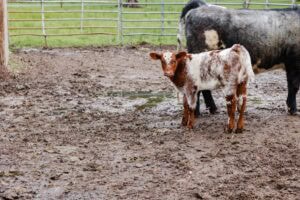
For the past 18 years, Nicholson, Jon, and their children, Addisen ’25 and Oliver ’30, have tended their land and livestock (40 sheep, two cows, two steers, four pigs, 50 chickens, and two ducks), waking up in the morning mist. Farming is a family affair — a full-time job — where everyone is responsible, whether it’s raining, snowing, or Christmas morning, delaying the opening of gifts.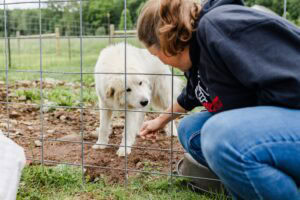
Nicholson said the farm affords the family another dimension to family life, apart from their career, jobs and schoolwork. “We have something to discuss other than school and work,” she said.“We have projects, and we have things that interest us, and we can problem-solve.” As a youngster who had a small farm with two horses and a handful of chickens, and as the wife of a husband whose family raised horses and cows, Nicholson said the responsibilities of farm life keep her kids out of trouble, much as her horses did for her. “The kids come home because they enjoy it,” she said, “and they like to be out in the barn. And then I think it’s really important for this generation, especially, to know how to work with their hands. My son can already drive, mend broken fences and pens without help.”
Nicholson is such an advocate for the impact of farming and tending to animals on young people that she introduced a Middle School Skills Incubator class, Farm 101, this year. She and the students visited local dairy farms (large-scale Oak Ridge and the family-operated Symth’s Trinity Dairy), Dondero Orchards, hydroponic rooftop gardens at Hartford Hospital, and discussed the politics of meat consumption. She aims to deepen students’ understanding of where food comes from and the challenges faced by modern agriculture.
Most days, Nicholson wakes at 4:00 a.m. to tackle schoolwork before the family arises. While she and the kids head to KO, Jon undertakes the farm chores, including feeding all the animals and ensuring the rest of the animals are healthy and have fresh water, nearly 40 gallons a day or one cow. In the evening, the entire family performs another round of chores. All four administer medicine to the animals when necessary and intervene when delivering lambs when required. “My husband and kids have gotten very good at assisting in delivery, “Nicholson said, “and are very proud of the animals they have helped.”
The Nicholsons raise their lambs, a flock of 40 or so cotton-faced Southdowns, sooty-faced Shropshires, and leggy Oxfords for show flocks, genetics for other farms, and for market as naturally as possible. After the sheep are fully grown, they either enter the Nicholson’s flock, are sold to other farms to build their flocks, or are USDA processed at Plymouth Meats, a meticulously clean, woman-run outfit that provides humane care at the end of the animals’ lives.
Nicholson dispels the notion that farm owners are closed off from their animals, unfeeling in their attitudes. “Animals are a livelihood, and you spend time in the morning and the evening with them,” she said. “You get to know them. Animals are living things, and when they fall ill, we do everything we can for them, but sometimes that is not enough. On market day, even when you steel yourself up for the day, it’s an emotional day. It weighs heavily on your heart.”
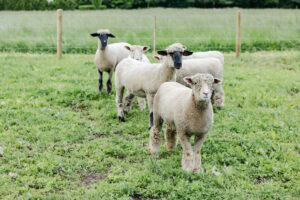
Breeders throughout the country prize Nicholson’s sheep for their genetics, and they are well-known on the show circuit. Jon and the children show their sheep nationally, from Massachusetts to Wisconsin, and the family is headed to Illinois this summer for a youth sheep show where 600 kids exhibit 3,000 head of sheep. When traveling, they use a college student studying vet tech to care for the farm. Although Addisen and Oliver have yet to garner the top prize of “supreme,” they earned “grand champion” for their Southdowns and Shropshires.“When I show, I get a lot of adrenaline,” Addisen said.“It’s a lot of fun, but sometimes you get a little frustrated if you know your sheep is great and it didn’t do as well as it should have.”
The Nicholsons continually add or deduct from their flock to create superior offspring.“We’re trying to grow genetics, our flocks, and our national name,” she said.“It’s what we’ve chosen to be known for as a farm. And you put as much into it as you get out of it financially and emotionally.” Currently, Addisen’s new project is her Oxford breed, where she is learning a new style of fitting and showing. Additionally, she is trying to improve the breed’s quality and wants to cultivate them to be easier keepers, with more body mass, so that they can be fed and kept
alongside the smaller-framed sheep. With only two breeding seasons, she is already seeing some success.
Although the farm is not a money-maker, the family budgets their resources consciously, keenly aware of profit and margins. A neighbor rents the multipurpose tobacco barn, which is used to cure tobacco from floor to ceiling from August through October for high-end cigar wrappers. Steam is used during the curing process to keep the tobacco supple, and Jon said that more than a few concerned drivers have stopped by to tell them their barn was on fire. Currently, that barn contains the two steers, one of which Oliver will show and sell at auction for his 4-H project
at the Big E this year. Jon estimates the cost of feeding and healthcare for a cow/steer is upwards of $4,000. The Nicholsons feed their livestock a high-quality grain of corn, oats,soybeans, or barley. Although it costs more, this approach produces higher-quality meat. They market their pork, lamb, and beef primarily through word of mouth, and also maintain a Facebook page. In the future, they plan to launch a website.
The farm has just weathered lambing season in January and February, when worries abound: cold temperatures, a sufficient food supply, fear of pneumonia, and the need to administer proactive vaccines. Although challenging, the winter months bring plenty of joy. “Even with all the worries and hard work, lambing season also brings the pleasure of watching newborn lambs bounce around the pen,” said Nicholson. “There is pride, but also something special about watching the animals being sheltered from the cold in a warm barn with newborn lambs and their moms, which grounds us as a family.”
“In the winter, you’re up every four hours to bottle feed the lambs or every hour or so to check on the ewes to make sure they are doing ok,” Nicholson said.“In the summer, it changes to evening work where you are training the lambs and getting them ready to show in a ring, be on a farm, be able to change from pen to pen on a halter, or stand there and not be afraid of things.”
Nicholson actively pursues public and private grants from the Connecticut Department of Agriculture, the USDA, and the American Farmland Trust to offset capital costs, a time-consuming process that entails crafting a persuasive argument, assessing risks, and obtaining letters of support. She received a grant from the state of Connecticut to establish a farm store within the year, complete with freezers and coolers to sell eggs and meat. She plans to open the store by the end of the summer, and already the small red store waits in place, with window boxes blooming with pansies. She plans to sell their eggs, sausage, bacon, and other cuts of meat (labeled under the Plymouth Farm name), as well as merchandise such as market bags made from their recycled grain bags.
Nicholson said that many grants require farms to employ regenerative farming practices to care for the land while producing food, an aspiration that Sand Meadow also embraces. Beyond their sheep pen lies 15 acres of open pastureland, featuring tall grasses. Once it’s sunnier and the land dries out, part of the meadow will be hayed, and when the grass is tall enough again, the land will be ready for grazing. The animals will be moved weekly to another section of pasture once their grazing is complete, allowing the grass to regrow and protect the soil’s health.
Although Nicholson and her husband both grew up on farms in their youth, there is still much to master when you own your own land. Nicholson is learning side by side with her students in her Skills Incubator class. She observed that many students experience a disconnect between their daily meals and the effort that goes into food production.“We’re moving further and further away from where our food comes from,” she said, noting how easily people assume food will always be available at grocery stores. COVID-19 supply chain disruptions heightened her awareness of the need to educate students on the complexities of agriculture.“I hope they take away a sense of connection to the food chain,” Nicholson said, “and feel empowered to make some decisions on how they eat and what they fuel themselves with.” The class encourages students not only to observe and learn but also to think critically about the impact of agriculture on their daily lives. Already, the learning is sticking. As one student said after visiting the dairy farm, “I can’t believe how much goes into a gallon of milk!”
Through Farm 101, Nicholson hopes that the students come away with practical research skills and a deeper appreciation for the effort, challenges, and care that go into providing food for society. And, some of them will be inspired to think about agriculture in new ways. As for the Nicholson family, life on the farm continues unabated following the natural rhythm. Next year will bring some challenges, as one of their steady farmhands, Addisen, heads off to college, requiring each of them to pick up the slack. Knowing the Nicholsons’ love and care for Sand Meadow, they will find a way to sustain their beautiful life.
Profiles Main News