
May 11, 2026
Student Presents Wheelchair Safety Research at International Conference
There are science fair projects, and then there are science fair projects. For KO junior Kenneth Sohn, his independent research rests in the latter category. His research journey is rooted in the question: How can technology improve everyday life for people who rely on it most?
Last month, Sohn took another significant step in that journey when he presented original research at the prestigious SPIE Defense + Security Conference, held near Washington, D.C., alongside co-researcher Antonio Gerber of the Watkinson School. Their poster presentation, “Monocular Vision-based 3D Obstacle Detection with a Single Degree-of-Freedom Roll Joint,” presented a practical affordable approach to improving wheelchair navigation and safety.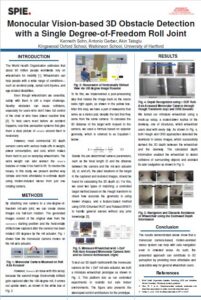
At the center of the project is a deceptively simple idea: instead of relying on expensive, bulky 3D sensors, the students developed a compact system using a single camera mounted on a rotating joint. Through image processing and computer vision, the system can estimate the 3D distance to nearby obstacles, helping wheelchairs navigate real-world environments more effectively. The result is a lighter, lower-cost alternative that could make advanced assistive technology more accessible to everyday users.
“This project wasn’t just about getting the code to work,” Sohn explained. “It was about asking how we could make advanced technology realistic for people who actually use wheelchairs.”
That mindset of balancing innovation with practicality reflects Sohn’s growing interest in biomedical engineering and medicine. For him, the project sits at the intersection of technical problem-solving and human-centered design. “It’s not enough for technology to be sophisticated,” he noted. “It has to genuinely help people in their daily lives.”
The students conducted initial testing using a miniature wheelchair platform, where the system demonstrated promising results in obstacle detection and spatial awareness. The research builds on earlier work Sohn presented in 2025 at a robotics convention, continuing a multi-year independent exploration into assistive mobility technologies. The work also earned recognition from SPIE, the international society for optics and photonics, which awarded Sohn a competitive student conference support grant. As part of the application process, Sohn submitted an essay explaining how participation in the conference would support his long-term academic and career goals. SPIE awarded him both a travel grant and a registration fee waiver to attend the conference in person.
For Sohn, the opportunity extended beyond presenting research. He engaged with professional engineers, scientists, and researchers from around the world. The manuscript and poster presented at the conference will be formally published in the Proceedings of SPIE through the SPIE Digital Library.
Sohn’s work reflects the kind of curiosity and sustained inquiry that grows when students are encouraged not simply to learn information, but to apply it in meaningful ways. It’s engineering with a clear human purpose, designing technology for the people who may one day depend on it.