
September 18, 2026
Student Wins First Place for Invention to Diagnosis Neurodegenerative Diseases
In a remarkable blend of science, compassion, and ingenuity, Rhea Doshi ’28 won first place in the senior division for life sciences and received the H. Joseph Gerber Medal of Excellence from the CT Academy of Science and Engineering for her groundbreaking invention — NeuroStride. Using artificial intelligence and machine learning, this diagnostic mat can detect early signs of neurodegenerative diseases such as Alzheimer’s, Parkinson’s, and mild cognitive impairment through a person’s gait, or walking pattern.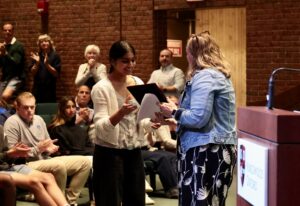
NeuroStride might sound futuristic, but its premise is elegantly simple. The six-to-eight-foot mat, embedded with pressure-sensitive sensors that work with artificial intelligence, maps a person’s gait. Within 30 seconds, the system generates a prediction score indicating the likelihood of early-stage neurological decline.“Gait is such a solid biomarker, and disease shows up 10 to 15 years before a diagnosis can be made, allowing us to make lifestyle changes early,” she said. ” I’m working in the medicine of prevention rather than reaction. We shouldn’t have to wait until people are sick to help them.”
NeuroStride has already entered clinical testing, beginning with a 100-patient trial through her mother’s private neurology practice. The data collected will feed back into the AI model, refining its accuracy. The next step will be a 500-patient study with institutions aiming to build a robust dataset for FDA 510(k) approval as a medical device. “We’re expecting the full validation process to take about two to three years,” Rhea says. “It’s a long road, but an exciting one.”
Doshi’s startup, Saranova Biotech, will lead the effort to commercialize the device, and she’s already begun her customer discovery journey, interviewing neurologists, physical therapists, and hospital staff. She says the feedback has been positive.
Doshi credits much of her success to the scientific environment she grew up in. Her mother, a neurologist, has not only provided guidance but also served as a role model for what women can achieve in STEM. “She’s very accomplished, and she’s been my inspiration since the beginning,” Doshi said. Her younger sister also plays a role, serving as a constant source of inspiration, and her father, she says, is always there for her.
Despite her extraordinary accomplishments, Doshi remains grounded. Outside of her scientific pursuits, she loves golf, photography, and art, often taking nature photos on family trips. Looking ahead, she hopes to study biotechnology and business. “That’s the dream,” she said, “the end goal. So I’ll do whatever I can to get there.”