
September 22, 2026
Teacher’s Dissertation to be Published as Book
For Upper School history teacher Gene Cassidy, a research project that began more than 15 years ago in Brazil’s archives is about to take on new life. Cassidy’s book proposal, Work as Civilization: Kultur, Slavery, and the Invention of Global German Identity, has been accepted for publication by Cambridge Scholars Publishing. Based on his doctoral dissertation, the book examines how ideas about slavery, labor, culture, and identity shaped German self-understanding and how German immigrants in Brazil used those ideas to make claims about rights and belonging.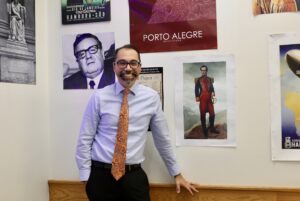
Cassidy began the research in earnest in 2011, spending an extended period in Brazil working in archives. Several years later, his research took him to Berlin, where he combed through collections at institutions including the Berlin State Library among other archives. Only then did the long process of writing his dissertation begin. The dissertation remained largely untouched until a friend recently sent him information about a publishing opportunity. With little to lose, Cassidy decided to submit a proposal. “The worst thing they could say is no,” he recalled. Instead, roughly two weeks after submitting the application, an email arrived with an offer and a contract.
Returning to writing he completed years ago has been an experience in itself. Cassidy laughed as he described rereading the dissertation and finding passages that still impressed him and others that clearly need attention. A few sections, I’m like, ‘Man, this is really good,’” he said. “And another section, I’m like, ‘I can’t believe I wrote this.’” And then there are the portions that elicited another reaction entirely: “Oh my God, this is so boring.”
Beyond editing the prose, Cassidy will need to revisit the scholarship that has emerged since he completed his original research. Because much of his bibliography is now more than a decade old, he plans to immerse himself again in academic journals, reviews, and newer scholarship. He has already reached out to a colleague at Arizona State University who studies Germans in 20th-century Brazil and is one of a relatively small group of scholars in the United States working in the field.
That return to scholarship also connects naturally to Cassidy’s work at KO. His research has long centered on questions that are at the heart of studying history: Who belongs? How do societies construct identity? How do ideas and institutions shape the rights people claim for themselves and grant to others?
Those same kinds of questions surface in his classroom. In his current IMPACT course, “Latin America(ans) in Politics and Media,” for example, students are exploring the narcotics trade, migration, and the U.S.-Mexico border through historical and contemporary lenses. Cassidy encourages students to investigate primary sources, compare perspectives, and draw their own conclusions. One assignment asks students to examine Saturday Evening Post coverage of immigration and life along the border from the 1920s and early 1930s and compare those portrayals with the ways similar subjects are presented today.
For Cassidy, however, the forthcoming book is also something more personal: an unexpected opportunity to see years of research become a tangible part of the scholarly record. He expects to submit the completed manuscript this spring, with publication anticipated in 2028. And while he readily acknowledges that Work as Civilization is intended for a specialized academic audience, he has one particularly meaningful measure of success in mind: seeing a copy in the University of Michigan library, where so much of his scholarly journey took shape. And, closer to home, he is looking forward to adding another faculty-authored volume to the shelves at KO. “I’m pretty psyched about that,” Cassidy said.